Schools

School EPC upgrades and the summer holiday working window

Schools have something no commercial building has: a long, completely empty, precisely scheduled possession every single summer, with shorter ones at Christmas and Easter. Nobody needs decanting, nothing needs working around, and the dates are published years in advance. The constraint is not access. It is the budget cycle.

A+ A B REQUIRED C D THIS BUILDING E F G
Band letters as they appear on a non-domestic certificate. Your own bands are on your EPC.

The trust, local authority or governing body, on an annual budget cycle that rarely matches the work.

Plan to the holiday, not to the quote

Six empty weeks is enough to do work that would take months around occupiers, at a far lower cost per fitting. Everything that would be awkward in a live building becomes straightforward: full floor possessions, daytime working, no out-of-hours premium, no protecting desks.

The practical consequence is that a school energy programme is planned backwards from a holiday. Specify in the autumn, procure in the spring, install in the summer. Missing the window costs a year, because the alternative is working around children.

Term-time occupancy is unusual too

A school is intensively occupied for roughly a third of the year and almost empty for the rest, and within term time it empties sharply at the end of the afternoon. That pattern suits controls unusually well: scheduling, occupancy sensing in halls and corridors, and setback outside term.

It also means annual consumption figures mislead. A measure sized against average occupancy will be wrong in both directions.

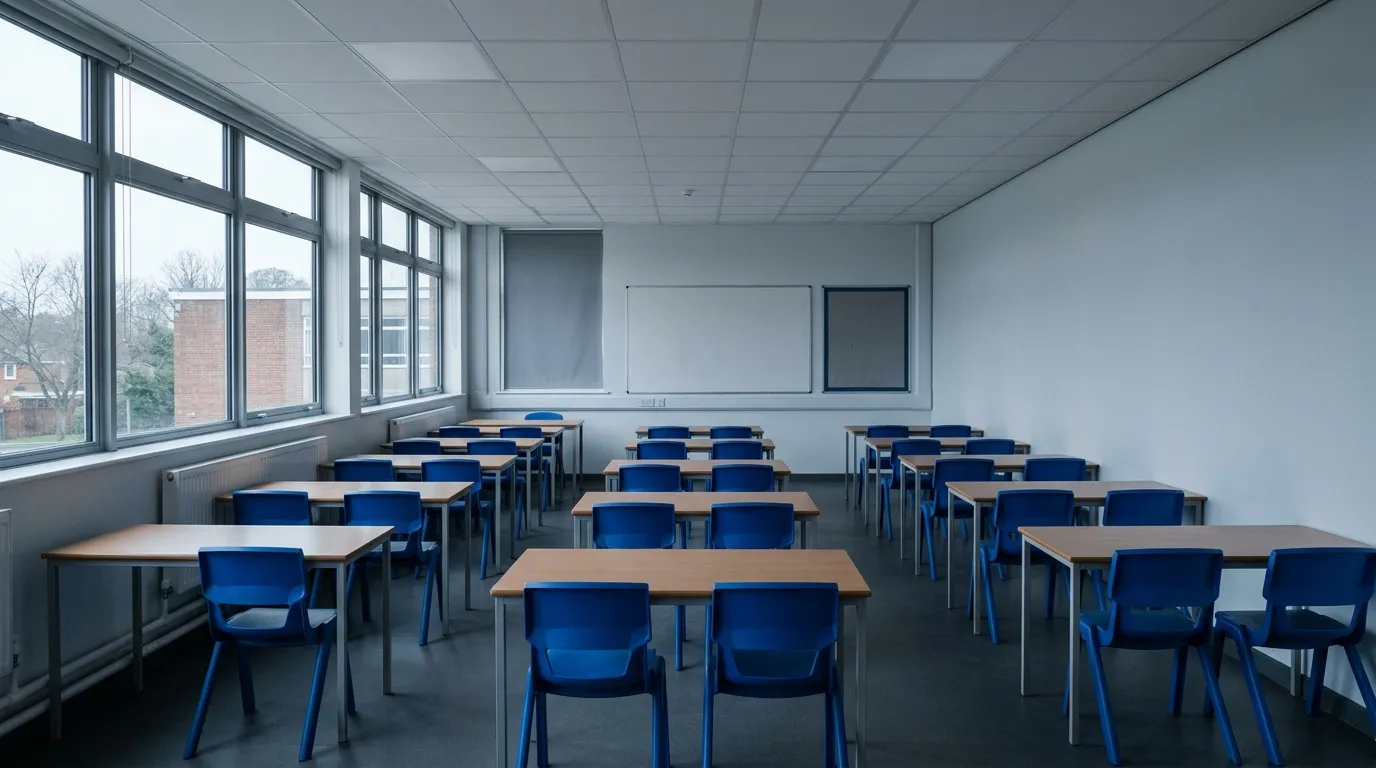
An empty school classroom with large windows, a suspended ceiling and rows of desks.
Illustrative image generated with AI. Not a photograph of a building we have worked on.

Daylight is usually already there

Classrooms are designed around daylight, often with large glazed areas and in many cases rooflights. That makes daylight-linked dimming genuinely effective here, rather than the marginal measure it is in a deep-plan office core.

The same glazing is frequently the fabric weakness, so the building that harvests daylight best also tends to lose the most heat through the same elements.

The estate is usually mixed, and that matters

Most school estates are not one building. They are a Victorian block, a 1970s teaching block, a recent sports hall and a collection of temporary classrooms, each with a different rating and a different cheapest measure.

Treating the estate as one project produces a compromise specification that suits none of it. The useful first piece of work is a building-by-building schedule, which is the same conclusion as a multi-let estate for entirely different reasons.

Questions we get asked

When should school energy work be done?
The summer holiday, almost always. Six fully empty weeks on published dates is the cheapest and least disruptive working window available to any building type. The programme has to be planned backwards from it, which usually means specifying the previous autumn.
Are lighting controls worth it in a school?
Unusually so. The occupancy pattern is sharp and predictable, halls and corridors are empty for long periods, and classrooms are designed around daylight, so daylight-linked dimming has real daylight to work with.
Should the whole estate be done at once?
Rarely. Most school estates mix buildings of very different ages, and the cheapest measure differs between them. A building-by-building schedule beats one estate-wide specification.

Last updated .

Next step

Get a quote for your school

One commercial contractor, quoting off a survey of the actual building rather than a rate per square foot over the phone.

Or call 07367 293494. Monday to Friday, 9am to 5.30pm.

A+ A B REQUIRED C D THIS BUILDING E F G
Call Get a quote