Lighting controls

Lighting controls and your commercial EPC rating

Controls are the measure people leave out of the quote and then wish they had not. Sensing, daylight dimming and zoning are credited in the assessment of a non-domestic building, they cost a fraction of a full fixture replacement, and they are far cheaper to install at the same time as the fixtures than to come back for later.

Often better value than fixtures alone
A+ A B REQUIRED C D THIS BUILDING E F G
Band letters as they appear on a non-domestic certificate. Your own bands are on your EPC.

Why controls are credited

The assessment does not just ask how much power your lighting draws. It asks whether the lighting is capable of drawing less when it does not need to be on. A fitting that dims when daylight floods the space, or switches off when a zone is empty, is modelled differently from an identical fitting on a single switch at the door.

That is a genuinely favourable quirk for a landlord. Controls are a modest capital item that affects an input the model treats seriously, and unlike fabric work they can go in without touching the structure.

The strategies, and where each one earns its money

  • Occupancy or absence detection. Best in spaces used intermittently — stores, plant rooms, WCs, meeting rooms, warehouse aisles. Worst in a space that is continuously occupied, where it does nothing.
  • Daylight dimming. Best where there is real daylight to harvest: rooflit warehouses, perimeter office zones, anything with significant glazing. Pointless in a windowless core.
  • Zoning. Splitting a large floor so you are not lighting all of it for the two people working late. Cheap at first fix, awkward and expensive to retrofit afterwards.
  • Time scheduling. Crude, cheap, and still the one that catches the most waste in retail and hospitality, where the real problem is lights left on after trading.
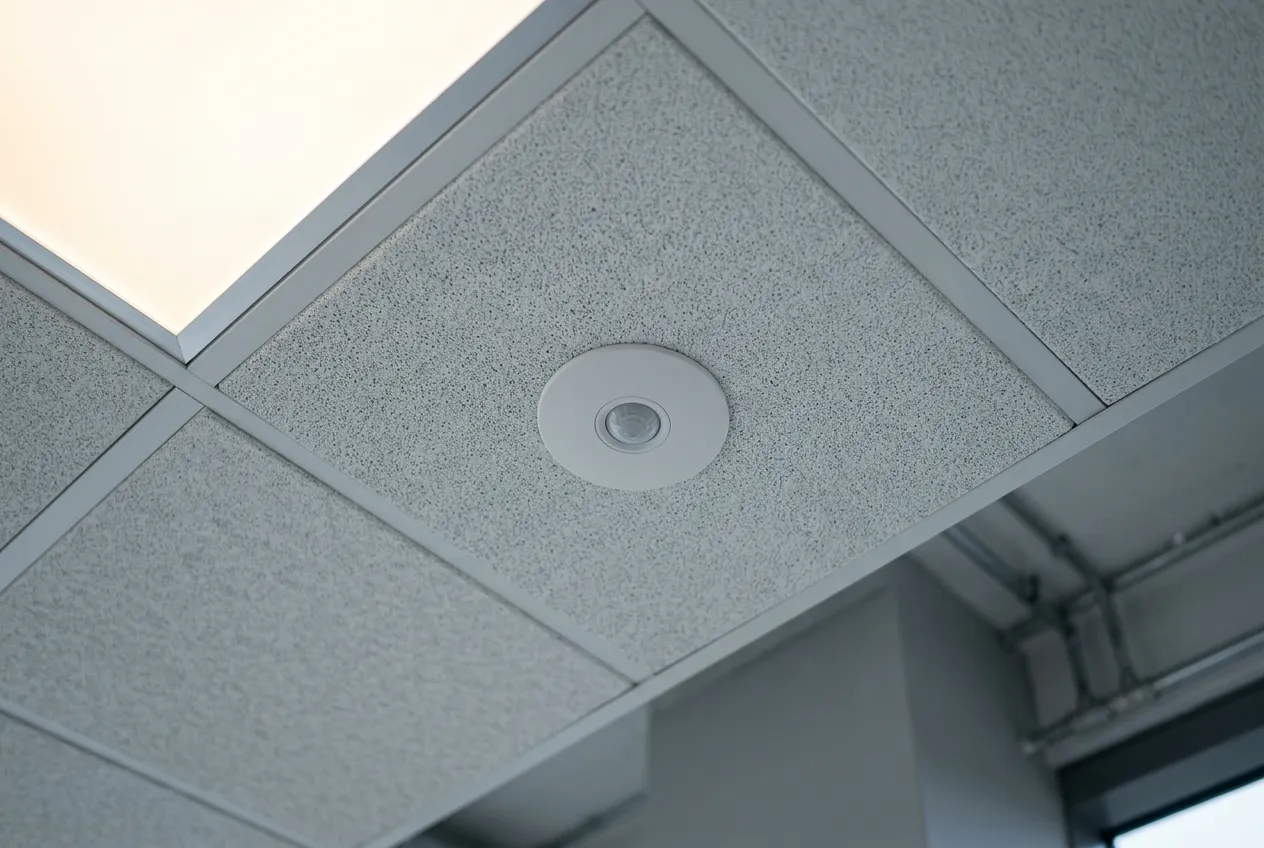
A ceiling mounted occupancy sensor set into an office ceiling tile beside a recessed light panel.
Illustrative image generated with AI. Not a photograph of a building we have worked on.

The mistake worth avoiding

Specifying controls for a space whose pattern of use does not suit them. Occupancy sensing in a continuously staffed production area adds cost, saves nothing, irritates the people working there, and gets disabled within a month — at which point you have paid for a measure that is no longer there when the building is reassessed.

Controls should be chosen zone by zone against how each space is actually used. A quote that applies one strategy across a whole building has not looked at the building.

Questions we get asked

Are controls worth it if I am already replacing the fixtures?
That is the cheapest moment to add them, because the access equipment, the electrician and the disruption are already paid for. Coming back later to add controls to new fittings means paying for all three a second time.
Will sensors annoy the people using the building?
Badly specified ones will. The usual culprits are too short a time delay and a detection pattern that does not cover where people actually sit still. Both are specification decisions rather than faults in the technology.
Do controls count on the EPC even if staff override them?
The assessment looks at what is installed and capable of operating, not at how occupants behave day to day. That said, controls that get disabled stop delivering the saving even while they still appear on the certificate — which is a good reason to specify ones people can live with.

Last updated .

Next step

Get lighting controls priced for your building

Tell us the building type, the floor area and the rating you are on now. One commercial contractor comes back to you with a quote off a survey.

Or call 07367 293494. Monday to Friday, 9am to 5.30pm.

A+ A B REQUIRED C D THIS BUILDING E F G
Call Get a quote