Workshops and light industrial

Workshop and light industrial lighting and EPC upgrades

A workshop is not a small warehouse. The eaves are low enough that mounting height stops being the dominant variable, the work happening in it needs good light at specific places rather than even light everywhere, and the person deciding is usually the person standing at the bench paying the electricity bill.

A+ A B REQUIRED C D THIS BUILDING E F G
Band letters as they appear on a non-domestic certificate. Your own bands are on your EPC.

Usually the occupier, who frequently owns the unit and pays the bill directly.

Task positions set the specification

In a warehouse you light aisles. In a workshop you light benches, machines and inspection areas, where people do close, sometimes hazardous work. Lighting the floor plate evenly is both more expensive and worse: it produces adequate general light and inadequate light exactly where it matters.

A specification worth paying for is set out against the layout of the work, with general lighting at a modest level and higher levels locally. That usually reduces total installed load rather than increasing it.

Low eaves change the cost basis

At four or five metres, the access equipment is a tower or a small lift rather than a MEWP, the fittings are ordinary rather than high bay, and much of the work can be done in a normal working day. That makes the cost per fitting lower than a shed and the job far quicker.

It also means the useful quote question changes. In a warehouse you ask about mounting height and access. Here you ask about fitting count against the bench layout and whether the existing circuits can be reused.

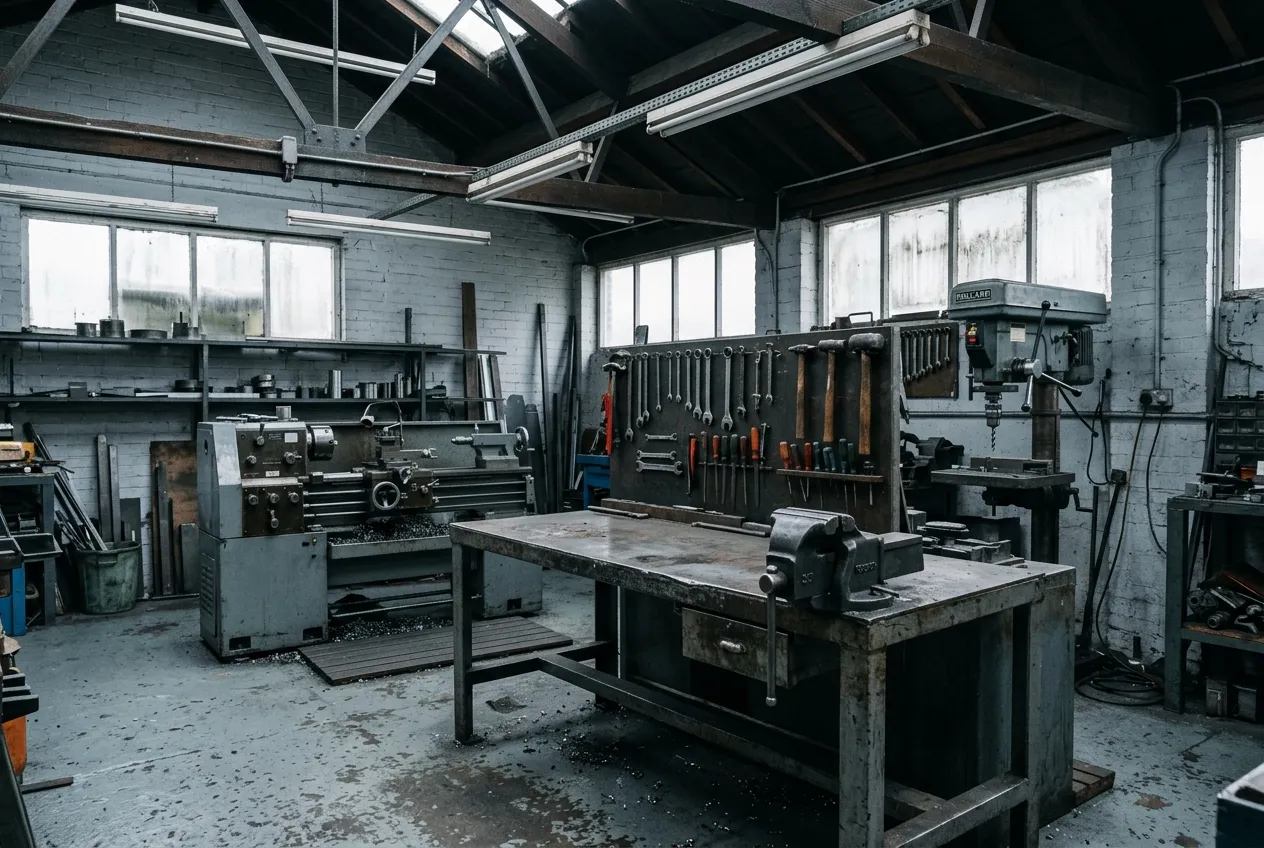
An empty engineering workshop with benches, machines and a low roof with lighting above.
Illustrative image generated with AI. Not a photograph of a building we have worked on.

Glare and colour rendering matter more than efficacy

Someone welding, machining, spraying or inspecting a finish needs to see detail and colour accurately, and needs not to be dazzled by a fitting in their line of sight. The most efficient fitting on the sheet is not automatically the right one.

This is the building type where a cheap specification is most likely to be rejected by the people using it, and lighting that gets switched off or supplemented with task lamps has saved nothing.

Owner-occupied changes the economics

In most of the building types on this site, the person holding the certificate and the person paying the electricity bill are different people, and that split is the main obstacle. In an owner-occupied workshop they are the same person, so the business case is simply payback.

That makes this one of the easiest building types to get a decision on, and one where the decision is usually made on running cost rather than on compliance.

Questions we get asked

How is workshop lighting different from warehouse lighting?
It is specified around benches and machines rather than aisles, the eaves are usually low enough that ordinary fittings and tower access replace high bay fittings and a MEWP, and glare and colour rendering matter more because of the work being done.
Can we reuse the existing wiring?
Often, in a like-for-like replacement at the same positions. It stops being likely as soon as the layout changes to follow the work rather than the old fitting positions, so ask for it to be stated in the quote either way.
Is it worth it in a small unit?
If the hours are long, usually yes, and in an owner-occupied unit the business case is simply payback rather than a split between landlord and tenant. Small units are also where sub-thousand-pound jobs genuinely exist.

Last updated .

Next step

Get a quote for your workshops and light industrial

One commercial contractor, quoting off a survey of the actual building rather than a rate per square foot over the phone.

Or call 07367 293494. Monday to Friday, 9am to 5.30pm.

A+ A B REQUIRED C D THIS BUILDING E F G
Call Get a quote